Friday, 18 May 2012

Organic Chem + Alkanes

Organic Chemistry is the study of CARBON COMPOUNDS
- Carbon forms multiple covalent bonds


Carbon Compounds can form chains, rings or branches
- There are less than 100,000 non-organic compounds
- Organic compounds number more than 17,000,000

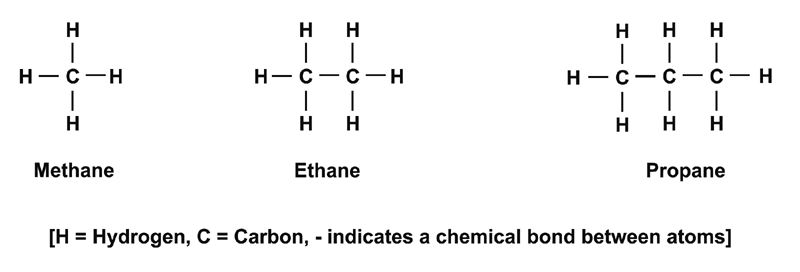
The simplest organic compounds are made of carbon and hydrogen


CH4 (Methane)


CH3CH3 (Ethane)


- Saturated compounds have no double or triple bonds
- Compounds with only single bonds are called Alkanes and always end in "-ane"


NOMENCLATURE


There are 3 categories of organic compounds
1) Straight chains
2) Cyclic chains
3) Aromatics


STRAIGHT CHAINS


Rules for naming straight chain compounds:
1) Circle the longest continuous chain and name the base chain
- meth, eth, prop, etc.
2) Number the base chin so side chains have the lowest possible numbers
3) Name each side chain using the "-yl" ending
4) Give each side chain the appropriate number
5) List side chains alphabetically


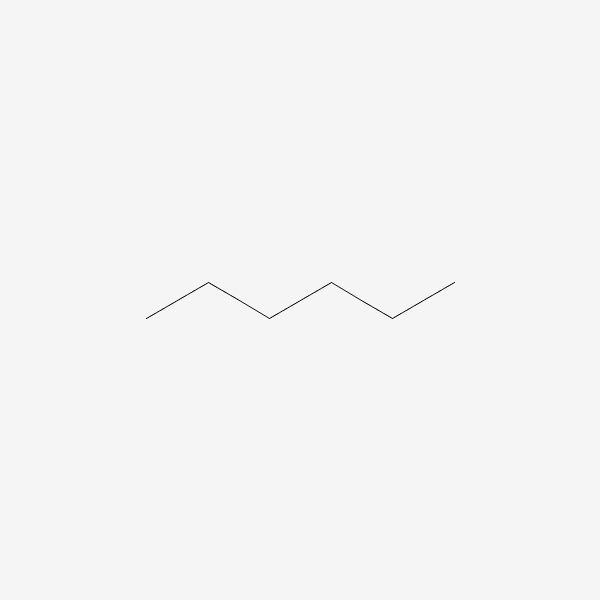
Name the Alkanes!! :


Ketones and Aldehydes

KETONES & ALDEHYDES

A ketone is a hydrocarbon chain with a double bonded oxygen that is NOT on either end
An Aldehyde is a compound that has a double bonded oxygen at the END of the a chain.
Follow standard rules and add -one to the parent chain for Ketones
Follow standard rules and change the parent name ending to -al in Aldehydes

Propanone is a ketone. Propanal is an aldehyde. Their endings and where the oxygens are bonded

Here are some examples:

Draw the structural diagrams for the following Ketones:


a) 2, 4 dimethyl 3 pentanone
b) 2 chloro 4 methyl 3 hexanone
c) 1,2,2 trichloro 4,4 difloro 3 butanone


Name the following compound:


2 ethyl 4 floro 2 methyl 3 hexanone


ALDEHYDES


An aldehyde is a compound that has a double bonded oxygen at the END of a chain So Oxygen atoms will be found on the ends of these chains, and will have an ending of -al


Name the compound:


1) Count 4 carbons = Butane
2) Add ending "-al" to Butane = Butanal


Answer: Butanal

The simplest aldehyde is methanal otherwise known as FORMALDEHYDE:


Draw a structural diagram for
2,3 dibromo 4 propyl pentanal


Alkynes and Alkenes

In Chem class, we learned about double & triple bonds, trans & cis butene

Carbon can form double & triple bonds with carbon atoms
When multiple bonds form, fewer hydrogens are attached to the carbon atom
Naming rules are almost the same as Alkanes (single bonds) but instead we use 2 different endings
For DOUBLE BONDS (Alkenes) it ends with -ene (i.e Butene)
For TRIPLE BONDS (Alkynes) it ends with -yne (i.e Heptyne)
*The position of the double/triple bonds always has the lowest number and is put infront of the parent chain

Double Bonds -ene


1. First determine the longest carbon chain. The longest Carbon chain here is 6, therefore we use the stem name -HEX


2. Next, you see a double bond represented by 2 lines (circled in red). Then you know our ending has to end with -ene. So it is 1 Hexene


3. Since you've found your parent chain (1 Hexene), determine the side chains. On #3 and #4 you see a 2 carbon group therefore it is 3,4 diethyl


4. So your answer is 3,4 diethyl hexene


Triple Bond: -yne

MULTIPLE DOUBLE BONDS:

More than 1 double bond can exist in a molecule
Use the same multipliers inside the parent chain


TRANS & CIS BUTENE

If 2 adjacent carbons are bonded by a DOUBLE BOND and have side chains on them 2 possible compounds are possible
CIS and TRANS:


Can you name this compound?


Answer: 4 ethyl, 4,5 dimethyl1 heptene

Functional Groups

Functional groups are organic compounds that can contain elements other than Carbon or Hydrogen. These organic compounds contain elements such as Oxygen (alcohols), group 7 elements (halides), double bonded oxygens (ketones/aldehydes), a combination of a double bonded oxygen and an OH group (carboxylic acids) and Nitrogens (Amines)

ALCOHOLS
HALIDES

We will learn about nine functional groups!!!

Alcohols
Halides
Aldehydes
Ketones
Carboxylic Acids
Ethers
Amines
Amides
Esters

ALCOHOLS:

An alcohol is a hydrocarbon with a -OH bonded
Its ending is -OL (i.e Methanol)
Same naming rules apply
If a compound has more than one -OH group number both and add -diol, -triol, -tetraol, etc
Examples:


After observing the structural diagram try to find some clues to start. From this diagram you see there is an OH, therefore you know this is an alcohol and has to end with -OL
Count the longest carbon chain. The longest carbon chain is 8. Therefore, it is 1 Octanol
Name the side chains from 1 Octanol. 3 ethyl, 4 propyl
The compound is 3 ethyl, 4 propyl 1 octanol
Name the following Alcohols:


On the left: You see 2 OH groups and a carbon chain of 2 (eth-). Since this is an alcohol with 2 OH groups, we name this Ethanediol
On the right: We know that this is a benzene molecule. But it is not exactly a benzene molecule because it has an OH group attached to it. This is called a Phenol.


HALIDES:


Group 7 elements (F, Cl, Br, I) can bond to a hydrocarbon chain
Naming follows standard rules with halides using
floro-, chloro-, bromo-, and iodo-


Left: a carbon chain of 2. (Ethane). The name of this compound is: 1,1,2,2 tetrabromo ethane
On the right: You see a carbon chain of 3, and one is double bonded (prop, -ene). The name of this compound is: 2,3 dibromo 3 chloro 1 Propene

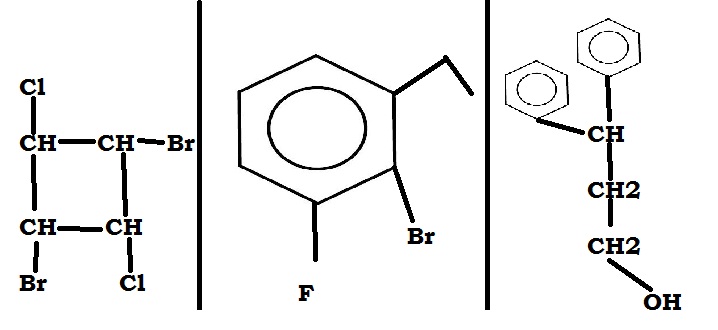
 Name the following compounds:


Answers:
(left) 1,3 dibromo 2,4 dichloro cyclobutane
(middle) 2 bromo, 1 ethyl, 3 floro benzene
(right) 3,3 diphenyl 1 propanol

Tuesday, 10 April 2012

Intermolecular Bonds:

Types of Bonds:

1. Intramolecular bonds = within a molecule (*think intramural)
    - Ionic + Covalent

2. Intermolecular bonds = between molecules (*think international)
    - The stronger the intermolecular bonds the higher the BP or MP
    - 2 Types: Vander Waals bonds & Hydrogen bonds

Vander Waals Bonds:

  • Based on electron distribution
  • 2 Categories: 
  1. Dipole - Dipole bonds 
  • if a molec. is Polar, the + end of one molec will be attracted to the - end of another molec. 

     2.  London Dispersion Forces (LDF)
  • present in all molecs
  • creates the weakest bonds 
  • if a substance is non-polar Dipole - Dipole forces don't exist 
  • electrons are free to move around & will randomly be grouped on one side of the molec. 
  • Creates a temporary dipole and can cause a weak bond to form
  • the more e- in the molec. the stronger the LDF will be
EX//

- NH3 (10e) VS. C2H8 (18e)
  polar                  non-polar

- NH3 has the stronger bond because of it's Dipole-Dipole bond.  C2H8 is non-polar thus it's bond is LDF making it's bond weaker than NH3.

Hydrogen Bonding:

  • if hydrogen bonded to certain elements (F, O, & N) the bond is highly polar 
  • this forms a very strong intermolecular bond.  
EX//

- H2O (10e) VS. CH4 (10e)
  Polar                 Polar

- They are both Polar and both have the same amount of e- but H2O wins for the highest boiling point due to its Hydrogen bond.

A very helpful Video... :)


Monday, 9 April 2012

Polar Molecules

What is polarity?

In chemistry polarity refers to a separation of electric charge leading to a molecule or its chemical groups having an electric dipole or multipole moment. Polar molecules interact through dipole–dipole intermolecular forces and hydrogen bonds. Molecular polarity is dependent on the difference in electronegativity between atoms in a compound and the asymmetry of the compound's structure.


*Things to remember
  • Polar molecules have an average charge seperation
  • Unsymmetrical molecules are usually polar
  • Molecular dipoles are the result of un = sharing of electrons in a molecule


Predicting Polarity
  • If a molecule is symmetrical, the pull of e- is usually balanced 
  • Molecules can be un-symmetrical in 2 ways
-- Diff atoms
-- Diff # of atoms


A molecule can possess polar bonds and still be nonpolar. If the polar bonds are evenly (or symmetrically) distributed, the bond dipoles cancel and do not create a molecular dipole. 


Here's a video that will explain things a bit more clearly....


Bonds

There are 3 main types of bonds in chemistry

1. Ionic (metal to non-metal)
Electrons are transferred from metal to non-metal

2. Covalent (non-metal to non-metal)
Electrons are shared between non-metals

3. Last but not least, Metallic (metal)
Holds pure metals together by electrostatic attraction

Electronegativity (en) is a measure of an atom's attraction for electrons in a bond

Atoms with greater electronegativity attract electrons

Polar Covalent bonds form from an unequal sharing of electrons, a polar covalent bond is a bond between two non-metals with different electronegativities. Unsymmetrical molecules are usually polar.
Non-Polar covalent bonds form from equal sharing of electrons, and are symmetrical molecules.
The type of bond formed can be predicted by looking at the difference in electronegativity (en) of the elements


Here are some examples!


Predict the type of bond formed.


1. H- O

2.20 - 3.44 = 1.24
This bond between Hydrogen and Oxygen is a Polar Covalent bond!


2. K-F


3.99 - 0.82 = 3.17
This bond between potassium and fluorine is an Ionic bond!

Now that we went through some examples together, let's see if you can do some on your own!

QUIZ TIME!!!! (: