Tuesday, 10 April 2012

Intermolecular Bonds:

Types of Bonds:

1. Intramolecular bonds = within a molecule (*think intramural)
    - Ionic + Covalent

2. Intermolecular bonds = between molecules (*think international)
    - The stronger the intermolecular bonds the higher the BP or MP
    - 2 Types: Vander Waals bonds & Hydrogen bonds

Vander Waals Bonds:

  • Based on electron distribution
  • 2 Categories: 
  1. Dipole - Dipole bonds 
  • if a molec. is Polar, the + end of one molec will be attracted to the - end of another molec. 

     2.  London Dispersion Forces (LDF)
  • present in all molecs
  • creates the weakest bonds 
  • if a substance is non-polar Dipole - Dipole forces don't exist 
  • electrons are free to move around & will randomly be grouped on one side of the molec. 
  • Creates a temporary dipole and can cause a weak bond to form
  • the more e- in the molec. the stronger the LDF will be
EX//

- NH3 (10e) VS. C2H8 (18e)
  polar                  non-polar

- NH3 has the stronger bond because of it's Dipole-Dipole bond.  C2H8 is non-polar thus it's bond is LDF making it's bond weaker than NH3.

Hydrogen Bonding:

  • if hydrogen bonded to certain elements (F, O, & N) the bond is highly polar 
  • this forms a very strong intermolecular bond.  
EX//

- H2O (10e) VS. CH4 (10e)
  Polar                 Polar

- They are both Polar and both have the same amount of e- but H2O wins for the highest boiling point due to its Hydrogen bond.

A very helpful Video... :)


Monday, 9 April 2012

Polar Molecules

What is polarity?

In chemistry polarity refers to a separation of electric charge leading to a molecule or its chemical groups having an electric dipole or multipole moment. Polar molecules interact through dipole–dipole intermolecular forces and hydrogen bonds. Molecular polarity is dependent on the difference in electronegativity between atoms in a compound and the asymmetry of the compound's structure.


*Things to remember
  • Polar molecules have an average charge seperation
  • Unsymmetrical molecules are usually polar
  • Molecular dipoles are the result of un = sharing of electrons in a molecule


Predicting Polarity
  • If a molecule is symmetrical, the pull of e- is usually balanced 
  • Molecules can be un-symmetrical in 2 ways
-- Diff atoms
-- Diff # of atoms


A molecule can possess polar bonds and still be nonpolar. If the polar bonds are evenly (or symmetrically) distributed, the bond dipoles cancel and do not create a molecular dipole. 


Here's a video that will explain things a bit more clearly....


Bonds

There are 3 main types of bonds in chemistry

1. Ionic (metal to non-metal)
Electrons are transferred from metal to non-metal

2. Covalent (non-metal to non-metal)
Electrons are shared between non-metals

3. Last but not least, Metallic (metal)
Holds pure metals together by electrostatic attraction

Electronegativity (en) is a measure of an atom's attraction for electrons in a bond

Atoms with greater electronegativity attract electrons

Polar Covalent bonds form from an unequal sharing of electrons, a polar covalent bond is a bond between two non-metals with different electronegativities. Unsymmetrical molecules are usually polar.
Non-Polar covalent bonds form from equal sharing of electrons, and are symmetrical molecules.
The type of bond formed can be predicted by looking at the difference in electronegativity (en) of the elements


Here are some examples!


Predict the type of bond formed.


1. H- O

2.20 - 3.44 = 1.24
This bond between Hydrogen and Oxygen is a Polar Covalent bond!


2. K-F


3.99 - 0.82 = 3.17
This bond between potassium and fluorine is an Ionic bond!

Now that we went through some examples together, let's see if you can do some on your own!

QUIZ TIME!!!! (:

Wednesday, 14 March 2012

Ion Concentration

Disssociation:

-Ionic Particles are made up of 2 parst:
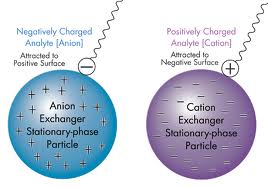
  • Cation: + charged particles
  • Anion: - charged particles


-When ionic compounds are dissolved in Water the cation and anion separate from each other
-This process is called dissociation.
-When writing dissociation equ'ns the atoms and charges must be ballanced
-The dissociation equ'n for NaCl is Na (+) + Cl (-)

EX// 

What are the following compound's Dissociation equ'ns?

-BaSO4 --> Ba (2+) + SO4 (2-)

-Al2(SO4)3 --> 2Al (3+) + 3SO4 (2-)

-If the volume doesn't change then the concentration of the individual ions depends on the balanced coefficients in the dissociation equ'n.

EX//

Determine the Ion Concentrations...

- 0.250 M of the sol'n KOH:

KOH --> K (+) + OH (-) 

0.250 mol/L x 1/1 + 0.250 M of [K+] 
*because there is a 1:1 ratio for this compound, [OH-] has the same ion concentration as [K+]. 

- A sol'n made from dissolving 2.5g of Ba3(PO4)2 in 50mL of water:

Ba3(PO4)2 --> 3Ba (2+) + 2PO4 (3+)

2.5g x 1 mol/601.9g= 0.00415mol / 0.050L = 0.831 mol/L x 3/1 = 0.249 M of [Ba 2+]
   "                     "                       "                           "              x 2/1 = 0.166 M of [PO4 3+]

A helpful video... :)

Solution Stiochiometry

What is Solution Stiochiometry? : Solution stoichiometry deals with reactions in solutions.


Types of Solution Reactions
   - Precipitation
   - Acid-base
   - Oxidation-reduction
   - Titrations

Example:
100 mL of 0.250 M Iron (II)chloride reacts with excess copper. How many grams of Iron are produced?

FeCl2 + Cu----> Fe + CuCl2

0.250 mol    x 0.100 L x 1     x 55.8 g  = 0.0250g 
           L                          1         mol


Example:
A beaker contains 100 mL of 1.5 M Hcl. Excess Zinc added to the beaker. Determine how many litres of hydrogen gas should be produced.

2HCl + Zn ---> H2 + ZnCl2

1.5 mol    x 0.100L x 1   x    22.4 L  = 1.68 L
        L                        2         mol     = 1.7 L


Here is a step-by- step video that shows you how to solve solution stoichiometry problems


Just in case if you didnt understand the previous video...


Solutions and Molarity

Solutions are homogeneous mixtures composed of a solute & a solvent
Solute: is the chemical present in lesser amount
(whatever is dissolved)
Solvent: the chemical present is the greater amount


Molarity


Concentration can be expressed in many ways. g/L, g/mL,mol/L, etc..

  • But the most common is Molarity mol/L= M
  • [HCL] concentration of HCl
  • [NaCl] concentration of NaCl


Heres a video that teaches you how to calculate molarity problems :)


Molarity= moles    
                Volume

Example:
What is the concentration of a Sodium chloride solution made from 0.75 mol of NaCl dissolved in 250 mL of water?
0.75 mol x     1      =   30 mol/L


Example:
What is the concentration of the solution when 2.75g of Sodium Carbonate are dissolved in 50 mL of water?

2.75g x     1   mol    = 0.0259
                 106 g      = 0.0260


Titrations

A Titration is a common laboratory experimental technique used to determine the concentration of an unknown solution. Because volume measurements play a key role in titration, it is also known as volumetric analysis.


Needed for a titration lab:


1. Buret
2. Stopcock
3. Pipet (Glass tube)
4. Erlenmeyer Flask
5. Indicators- Used to identify the end point of filtration
6. Stock solution - Known Solution


Mike the explorer completed a titration of 0.330 M NaOH with 15.00 mL samples of HI of unknown concentration. The data he gathered is below. Determine the concentration of HI.


Subtract the final reading from the initial reading to get the Volume used.


Next we add up 11.2 mL + 10.9 mL + 11.4 mL = divide by 3 = 11.16666667 mL
Doing this gets us the average, but notice how we don't count the volume that was far off.


Next we change 11.16 mL into L

11.16 x 1L/1000 mL
= .0111L

Then, we take our concentration and change that into Moles of HI

0.330 M x .011 L = .00363 x 1 = 0.00363 mol
L 1


Finally, we take 0.00363 mol
and divide it by the 15.00 mL, but remember to convert into L!!


15.00 mL x 1 L/1000 mL
= .015 L


0.00363 mol/ 0.015 L
= .246 M