Elements close to each other on the periodic table display similar characteristics.
- There are SEVEN important periodic trends:
1) Reactivity
2) Ion Charge
3) Melting point
4) Atomic Radius
5) Ionization Energy
6) Electronegativity
7) Density
We will only be talking about the first 6, today!
REACTIVITY:
metals and non-metals show different trends.
the most reactive metal is Francium; the most reactive non-metal is fluorine.
ION CHARGE:
Elements ion charges depend on their group (column).
MELTING POINT:
elements in the center of the table of the highest melting point.
noble gases have the lowest melting points.
starting from the left to right, melting point increases, until the middle
carbon is an exception!
ATOMIC RADIUS:
radius decreases to the up and the right.
helium has the smallest atomic radius.
Francium has the largest atomic radius.
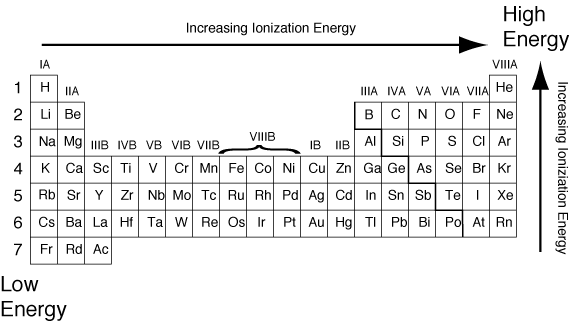
IONIZATION ENERGY:
ionization energy is the energy needed to completely remove an electron from an atom.
Scientists discovered that an atom contains 3 fundamental particles: Protons, neutrons, & electrons. All atoms of a given element areidentical because they have they same number of protons & electrons. However, it does not mean that all atoms have the same number of neutrons.
Since all elements have different properties, scientists refer to the periodic table
Each element is listed in squares in the periodic table which provides information about a particular element. Scientists know where to specifically look when they are trying to identify an element.
Scientists look for:
A= Atomic # (protons & electrons)
B=Ion charges
C= Abbreviation of element
D=Element
E=Atomic mass
The only subatomic particle that does not appear on the Periodic Table is the Neutron. But it's no big deal since the Neutron can be easily found by using this simple formula. Atomic mass- Atomic Number = # of Neutrons.
And since ATOMS do NOT have the same number of Neutrons they are called Isotopes. Hydrogen has isotopes...
Same with Lithium...
Mass Spectrometers are used to determine the abundance & mass if the isotopes of elements.
Or you can simply just use the formula: mass x abundance = atomic mass. THIS video will give a Clear understanding of how to find atomic masses. Enjoy!
The electron is a particle that must be in orbital in the atom
Quantum Theory
The electron is the cloud of negative charge in a wave function
Orbitals are areas in 3D space where the electrons most probably are
The energy of the electrons is in it's vibrational nodes
Photons are produced when high energy modes change into lower energy modes
Determining an elements chemical properties is it's electron configuration, particularly the valence shell electrons. The type of orbital the atom's outermost electrons reside determines the 'block' and the number of valence shell electrons determine the 'group'.
The total number of electron shells detemines the period it belongs and each shell is divided into sub-shells
Subshell:
S
G
F
D
P
Period
1
1s
2
2s
2p
3
3s
3p
4
4s
3d
4p
5
5s
4d
5p
6
6s
4f
5d
6p
7
7s
5f
6d
7p
8
8s
5g
6f
7d
8p
Through a group of lightest element to heaviest element, the outer shell electrons are all in the same orbital, with a very similar shape, but increasingly higher energy and distance from the nucleus. The outer shell, for instance, all have one electron in an s-orbital. In hydrogen, the s-orbital is the lowest possible energy state of any atom, the first.
The different regions of the atomic table are named according to the sub-shell in which the last electron is...
S-Orbital
- Each Orbital holds two electrons
- Spherically symmetric around the nucleus
- Only has one orbital
P-Orbital
- There are 3 sub-orbitals
- Each Orbital contain 2 electrons
- In total, there are 6 electrons
D-Orbital
- There are 5 sub-orbitals
- Each orbital contains 2 electrons
- In total, there are 20 electrons
F-Orbital
- There are 7 sub-orbitals
- Each contain 2 electrons
-In total, there are 14 electrons
Here's a really helpful video to help understand electron configuration
Lets see if you can do some! (:
1. What is the electronic configuration for nickel?
2. What is the electronic configuration for Gold?
3 What is the electronic configuration for Zinc?
The Bohr model: was introduced my Neils Bohr in 1913. He introduced that surronding the positively charged nucleus was electrons. His idea is somewhat similar to the solar system with the exception that electrostatic forces provide attraction not gravity. At some point Bohr and Rutherford's models were "combined" since Bohr's model is like a quantum physics based modification of Rutherford's model; people called it the "Bohr-Rutherford model. "
-Rutherford's model was inherently unstable
Protons and Electrons should attract eachother
-Matter emits light when it is heated (backbody radiation)
Light travels as a photon
. Energy photons carry depends on their wavelength
e.g: radio stations such as the beat 94.5 <---- the 94.5 actually represents frequency radio waves
(FM has more energy than AM)
These lines in the emission spectrum are unique set of lines for each element. Each line represents a Photon of light emitted from the excited atom. Bohr based his model on the energy (light) emitted by different atoms. Each atom has a specific spectra of light. To explain this emission spectra, he suggested that electrons occupy Shells or Orbitals
Bohr's Theory
- Electrons exist in orbits
- when they absorb energy they move to a higher orbital
- As they fall from a higher orbital to a lower one they release energy as a photon of light.
Here is an educational video that explains a bit more about Bohr's theory. :)